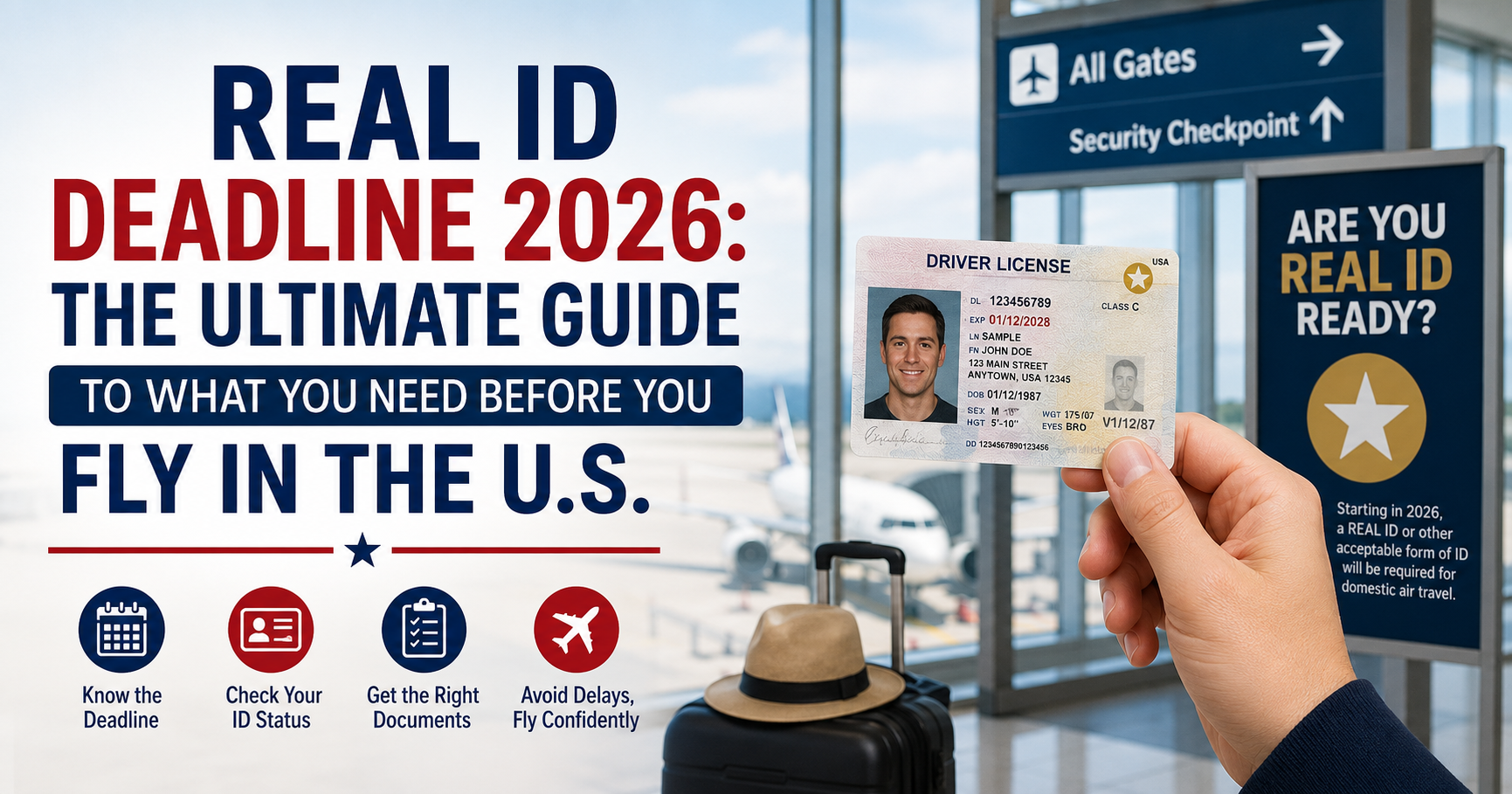
The REAL ID is a federally compliant driver’s license or identification card that meets higher security standards established by the U.S. government. It was created to improve identity verification and make identification documents more secure.
A REAL ID looks similar to a regular driver’s license, but it contains a special symbol—usually a gold or black star—in the upper-right corner. This star indicates that the card meets federal requirements.
Beginning with the REAL ID deadline, travelers using domestic commercial flights must show either a REAL ID-compliant license or another acceptable identification, such as a valid U.S. passport.
The program is designed to reduce identity fraud while making travel more secure across the country.
Quick Answer
If you’re planning to fly within the United States, the REAL ID deadline is one of the most important travel rules to know. Adults aged 18 and older must present a REAL ID-compliant driver’s license or another TSA-approved identification, such as a passport, when boarding domestic flights.
If you don’t have a REAL ID after the deadline, you may be denied entry through airport security unless you carry another accepted form of identification.
Key Features of a REAL ID
| Feature | REAL ID |
| Accepted for domestic flights | ✅ Yes |
| Federal security standards | ✅ Yes |
| TSA approved | ✅ Yes |
| Used for federal facilities | ✅ Yes |
| Star marking | ✅ Yes |
What Is the REAL ID Deadline?
The REAL ID deadline is the date when federal agencies, including the Transportation Security Administration (TSA), begin requiring travelers to present a REAL ID-compliant driver’s license or another approved identification for domestic air travel.
After this deadline:
- Standard driver’s licenses without REAL ID compliance will no longer be accepted for TSA security screening.
- Travelers must present another federally accepted ID if they do not have a REAL ID.
- Airport security checks become stricter to improve national security.
Many travelers mistakenly believe they can continue using an old driver’s license forever. However, once the REAL ID requirement is fully enforced, failing to bring proper identification could delay or prevent your trip.
Why the Deadline Matters
Imagine arriving at the airport with only a regular driver’s license that isn’t REAL ID compliant. TSA officers may refuse it, causing you to miss your flight unless you have another approved ID.
That’s why millions of Americans are updating their driver’s licenses before the REAL ID deadline arrives.
Why Was the REAL ID Act Created?
The REAL ID Act was passed to strengthen identification standards across all U.S. states.
Before REAL ID, each state had different rules for issuing driver’s licenses. This made it easier for fake identities and fraudulent documents to be created.
The law introduced:
- Better identity verification
- Improved document security
- More consistent state licensing standards
- Stronger protection against identity fraud
These changes help government agencies confirm that identification documents belong to the correct individual.
Main Goals of REAL ID
- Increase aviation security
- Prevent identity fraud
- Standardize state-issued IDs
- Improve national security
- Make government-issued IDs more reliable
Who Needs a REAL ID?
Not everyone needs a REAL ID immediately. However, many adults will benefit from getting one before the deadline.
You should obtain a REAL ID if you:
- Fly within the United States
- Visit certain federal government buildings
- Enter secure federal facilities
- Access some military bases (where required)
Even if you don’t fly often, having a REAL ID can make future travel much easier.
Travelers Who Should Prioritize Getting One
- Business travelers
- Vacation travelers
- Students studying in another state
- Families flying with children
- Frequent flyers
- Government contractors
Who Doesn’t Need a REAL ID?
Some people may not need a REAL ID because they already possess another federally accepted form of identification.
Examples include:
- U.S. Passport holders
- Passport Card holders
- Military ID holders
- Trusted Traveler Cards
- Permanent Resident Cards
If you already travel with one of these documents, you can continue using it for domestic flights even after the REAL ID deadline.
However, many people still choose to obtain a REAL ID because it’s easier to carry than a passport for everyday travel.
Children Under 18
Children traveling with an adult generally do not need their own REAL ID for domestic flights.
However, airlines may have separate identification requirements, so parents should always verify airline policies before traveling.
How to Check If Your License Is REAL ID Compliant

One of the easiest ways to determine whether your driver’s license meets federal requirements is to examine the upper-right corner.
Most REAL ID cards display one of the following:
- Gold Star
- Black Star
- Gold Circle with Star
- State-specific REAL ID symbol
The design varies by state, but every compliant license includes a federally approved marking.
Other Ways to Check
You can also:
- Visit your state’s DMV website
- Contact your local DMV office
- Review the information printed on your license
- Ask during license renewal
If you’re unsure, checking before your next flight can help you avoid unnecessary stress.
REAL ID vs Standard Driver’s License
Many people think these licenses are identical, but there are important differences.
| Feature | REAL ID | Standard License |
| Domestic Flights | ✅ Yes | ❌ No (after deadline) |
| Federal Buildings | ✅ Yes | Limited |
| Identity Verification | Enhanced | Standard |
| TSA Accepted | ✅ Yes | ❌ No |
| Security Standards | Federal | State |
The biggest difference is that only a REAL ID meets federal identification requirements for domestic air travel after the enforcement deadline.
Why Upgrade?
If you already renew your driver’s license regularly, upgrading to a REAL ID can save time and eliminate the need to carry a passport on domestic trips.
Many travelers find it to be the most convenient option for flying within the United States.
REAL ID vs. U.S. Passport
Many travelers wonder whether they need a REAL ID if they already have a valid U.S. passport. The good news is that both documents are accepted for domestic flights, but they serve different purposes.
A REAL ID is primarily designed for everyday identification and domestic travel. A passport, on the other hand, is required for international travel and can also be used as identification for domestic flights.
If you travel only within the United States, carrying a REAL ID is usually more convenient because it fits in your wallet like a standard driver’s license. If you frequently travel abroad, you’ll still need a passport regardless of whether you have a REAL ID.
REAL ID vs Passport Comparison
| Feature | REAL ID | U.S. Passport |
| Domestic Flights | ✅ Yes | ✅ Yes |
| International Flights | ❌ No | ✅ Yes |
| Driver’s License | ✅ Yes | ❌ No |
| Everyday Identification | ✅ Yes | Yes (less convenient) |
| Fits in Wallet | ✅ Yes | ❌ No |
| TSA Accepted | ✅ Yes | ✅ Yes |
Which One Should You Choose?
Your choice depends on your travel needs.
Choose a REAL ID if you:
- Mostly travel within the U.S.
- Want a convenient everyday ID.
- Need a federally compliant driver’s license.
Choose a passport if you:
- Travel internationally.
- Already carry your passport regularly.
- Need proof of U.S. citizenship for international trips.
Many Americans choose to have both, giving them maximum flexibility.
Documents Needed to Get a REAL ID
One of the biggest reasons applications are delayed is missing paperwork. Before visiting your state’s DMV, gather all the required documents.
Although requirements vary slightly by state, you’ll generally need documents proving your identity, Social Security number, and residency.
Required Documents Checklist
| Requirement | Examples |
| Proof of Identity | U.S. Passport, Birth Certificate |
| Social Security Number | SSN Card, W-2, Pay Stub |
| Proof of Residency | Utility Bill, Bank Statement, Lease Agreement |
| Legal Name Changes (if applicable) | Marriage Certificate, Court Order |
Acceptable Proof of Identity
Examples include:
- Valid U.S. Passport
- Certified Birth Certificate
- Permanent Resident Card
- Certificate of Citizenship
Only original or certified copies are usually accepted. Photocopies are generally not allowed.
Proof of Social Security Number
Most DMVs accept:
- Social Security Card
- W-2 Form
- Paycheck Stub
- SSA-1099 Form
Proof of Residency
You’ll usually need two documents showing your current address, such as:
- Electric bill
- Water bill
- Mortgage statement
- Rental agreement
- Credit card statement
- Bank statement
- Vehicle registration
Always check your state’s DMV website because acceptable documents can differ.
How to Apply for a REAL ID
Applying for a REAL ID is straightforward if you’re prepared.
Step 1: Check Eligibility
Confirm you’re eligible to receive a REAL ID in your state.
Step 2: Gather Documents
Collect all required paperwork before visiting the DMV.
Missing even one document could mean another trip.
Step 3: Schedule a DMV Appointment
Many states recommend scheduling an appointment instead of walking in.
Appointments usually reduce waiting times significantly.
Step 4: Visit the DMV
Bring:
- Required documents
- Current driver’s license
- Payment for applicable fees
A DMV employee will review your documents and verify your identity.
Step 5: Have Your Photo Taken
You’ll receive a new photograph for your updated REAL ID license.
Step 6: Receive Your Card
Some states issue a temporary paper license while your REAL ID arrives by mail.
Delivery often takes several business days to a few weeks.
Can You Apply Online?
Many people hope to complete the process online, but most first-time REAL ID applications require an in-person visit.
That’s because DMV staff must verify your original identity documents.
However, some states allow you to:
- Upload documents in advance
- Begin your application online
- Schedule appointments
- Pay certain fees electronically
This can speed up your DMV visit.
How Much Does a REAL ID Cost?

The cost varies depending on your state.
In many states, upgrading to a REAL ID costs about the same as renewing a driver’s license.
Estimated Costs
| Situation | Typical Cost |
| New License | Varies by State |
| Renewal | Standard Renewal Fee |
| Duplicate Card | State Fee Applies |
| First-Time REAL ID | Usually Standard License Cost |
Some states charge no additional fee beyond the normal driver’s license renewal cost.
Always verify pricing with your local DMV before applying.
How Long Does It Take to Get a REAL ID?
Processing times differ across the country.
Typical Timeline
| Step | Estimated Time |
| DMV Appointment | 20–60 Minutes |
| Document Verification | Same Day |
| Temporary License | Immediately (if offered) |
| REAL ID Arrival | 1–4 Weeks |
During busy travel seasons, processing may take longer.
Applying well before your next flight is always recommended.
Renewing a REAL ID
Renewing a REAL ID is often easier than applying for one for the first time.
Depending on your state’s rules, you may be able to renew:
- Online
- By mail
- In person
If your name or address has changed, you may need to provide updated documentation.
Renew your REAL ID before it expires to avoid any interruptions in your ability to use it for domestic air travel.
What Happens If You Miss the REAL ID Deadline?
If you arrive at the airport after the enforcement deadline with only a non-compliant driver’s license, you could face significant delays—or even be denied access to the security checkpoint.
However, you can still travel if you present another TSA-approved form of identification, such as:
- U.S. Passport
- Passport Card
- Military ID
- Permanent Resident Card
- Trusted Traveler Card (where accepted)
Without any acceptable ID, TSA may not allow you to board your flight.
Special Situations
College Students
Students flying home or traveling between campuses should make sure they have a REAL ID or another accepted form of identification before booking flights.
Seniors
Older adults should check expiration dates and renew early to avoid last-minute issues.
Military Personnel
Active-duty military members can typically use their military ID for domestic flights.
Permanent Residents
Permanent Resident Cards are generally accepted as TSA-approved identification for domestic air travel.
Tips to Make Your DMV Visit Easier
- Schedule an appointment in advance.
- Double-check your documents before leaving home.
- Bring original or certified copies.
- Arrive early.
- Keep copies of your paperwork for your records.
- Verify your mailing address before submitting the application.
A little preparation can save hours of frustration.
REAL ID Travel Checklist

Before heading to the airport, use this simple checklist to make sure you’re ready for a smooth trip after the REAL ID deadline.
✔ Before You Fly
| Task | Complete |
| Check that your driver’s license is REAL ID compliant | ☐ |
| Look for the gold or black star on your ID | ☐ |
| Verify your ID has not expired | ☐ |
| Pack your REAL ID or another TSA-approved ID | ☐ |
| Confirm your airline reservation details | ☐ |
| Arrive at the airport at least two hours early | ☐ |
| Keep your ID easily accessible | ☐ |
Completing this checklist can help you avoid unnecessary stress and delays at airport security.
Pros and Cons of Getting a REAL ID
While a REAL ID is highly recommended for most travelers, it’s helpful to understand both its benefits and limitations.
| Pros | Cons |
| Accepted for domestic flights | Requires extra documents to apply |
| Meets federal security standards | Usually requires an in-person DMV visit |
| Convenient wallet-sized identification | Processing times vary by state |
| Can be used for some federal facilities | Does not replace a passport for international travel |
| Reduces travel hassles | Appointment availability may be limited during busy periods |
For most U.S. travelers, the advantages of having a REAL ID outweigh the inconvenience of applying for one.
Common Mistakes to Avoid
Many applicants run into problems simply because they overlook small details. Avoid these common mistakes to make the application process smoother.
1. Waiting Until the Last Minute
DMVs often experience high demand as important deadlines approach. Waiting too long could mean limited appointment availability or delayed card delivery.
Tip: Apply several weeks before any planned travel.
2. Bringing the Wrong Documents
One of the most common reasons applications are delayed is incomplete or incorrect paperwork.
Tip: Review your state’s DMV requirements before your appointment.
3. Assuming Every Driver’s License Is a REAL ID
Not all licenses are REAL ID compliant. Check your card for the required star symbol.
4. Forgetting Name Change Documents
If your current legal name differs from your birth certificate, you’ll likely need supporting documents such as:
- Marriage certificate
- Divorce decree
- Court order
5. Ignoring Expiration Dates
A REAL ID is only useful if it’s valid. Renew it before it expires, especially if you have upcoming travel plans.
6. Not Checking State Requirements
Although REAL ID is a federal program, states may have slightly different documentation rules.
Always verify the latest requirements with your state’s DMV.
Expert Tips for a Hassle-Free REAL ID Application

Experienced travelers and DMV professionals recommend these best practices.
Apply Early
Don’t wait until just before a vacation or business trip. Applying early gives you time to resolve any unexpected document issues.
Make an Appointment
Booking an appointment can significantly reduce waiting times compared to walk-in visits.
Organize Your Documents
Keep all required paperwork in a folder before visiting the DMV. This helps prevent forgotten documents.
Keep a Backup ID
Even after receiving your REAL ID, carrying a valid passport on major trips provides extra peace of mind.
Check Your Mail Carefully
Your REAL ID will usually arrive by mail. If it doesn’t arrive within the expected timeframe, contact your DMV promptly.
REAL ID: Myths vs. Facts
| Myth | Fact |
| REAL ID is required for everyone. | It’s mainly required for certain federal purposes, including domestic flights. |
| A REAL ID replaces a passport. | False. You still need a passport for international travel. |
| Every driver’s license is already REAL ID compliant. | No. Only compliant licenses display the required marking. |
| Children need a REAL ID to fly domestically. | Generally, children under 18 do not need one when traveling with an adult. |
| You can always apply online. | Most first-time applicants must visit the DMV in person. |
FAQs
What is the REAL ID deadline?
The REAL ID deadline is the date after which adults flying within the United States must present a REAL ID-compliant driver’s license or another TSA-approved form of identification for domestic air travel.
Can I still fly without a REAL ID?
Yes, but only if you use another TSA-approved identification, such as a valid U.S. passport or military ID.
How can I tell if my license is REAL ID compliant?
Look for a gold or black star (or your state’s approved REAL ID symbol) in the upper-right corner of your driver’s license or identification card.
Do children need a REAL ID?
Generally, no. Travelers under 18 usually do not need identification for domestic flights when traveling with a companion, though airline policies may vary.
Is a passport better than a REAL ID?
It depends on your travel needs. A passport is required for international travel, while a REAL ID is a convenient option for domestic flights.
Can I apply for a REAL ID online?
In many states, you can begin the application online, but first-time applicants typically need to visit a DMV office to verify original documents.
How long does it take to receive a REAL ID?
Processing times vary by state, but most people receive their REAL ID by mail within one to four weeks after applying.
How much does a REAL ID cost?
Fees vary by state. In many cases, the cost is similar to renewing or replacing a standard driver’s license.
What documents do I need?
Most applicants need proof of identity, proof of Social Security number, and two documents showing residency. Additional documents may be required if your legal name has changed.
Does a REAL ID expire?
Yes. Like a standard driver’s license, a REAL ID has an expiration date and must be renewed according to your state’s renewal schedule.
Conclusion
The REAL ID deadline is an important milestone for anyone who plans to fly within the United States. Taking the time to upgrade your driver’s license now can save you from unnecessary delays and travel disruptions later. By gathering the correct documents, scheduling your DMV appointment early, and verifying that your new card is REAL ID compliant, you’ll be well prepared for future domestic trips.
Whether you’re traveling for work, visiting family, or planning your next vacation, having a REAL ID offers added convenience and peace of mind. If you’re unsure about your state’s requirements, check with your local DMV well before your next flight. Preparing today means you can focus on enjoying your journey tomorrow
Read More: REAL ID Deadline 2026: Ultimate Guide to What You Need Before You Fly in the U.S.