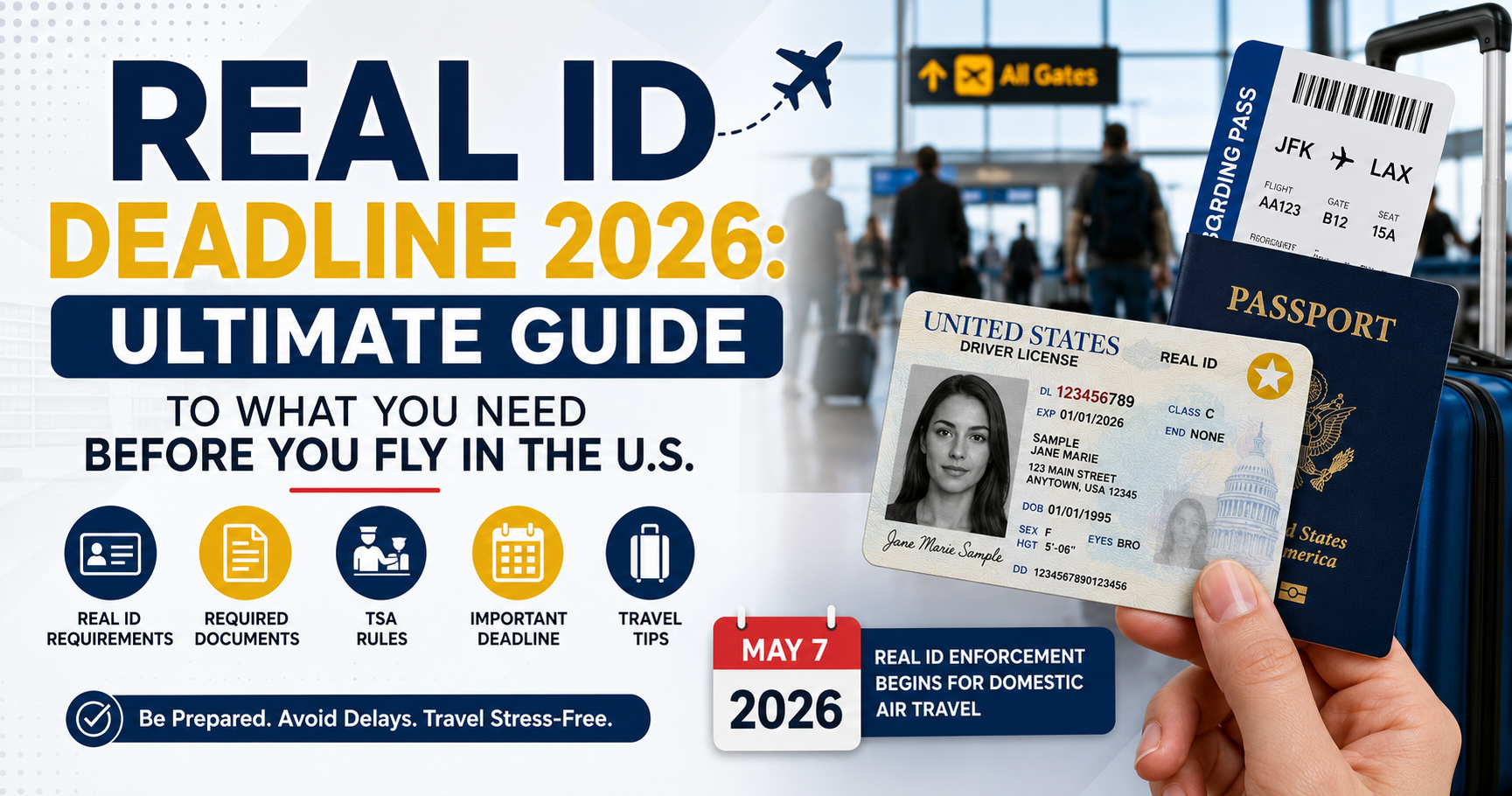
Planning a flight within the United States? One of the most important things to check before packing your bags is whether your identification meets federal requirements. The REAL ID deadline has changed how millions of Americans prepare for domestic travel, making it essential to know if your driver’s license is compliant.
Many travelers arrive at the airport expecting to board their flight, only to discover their standard driver’s license is no longer enough for TSA screening. Understanding the REAL ID deadline can save you from unnecessary stress, missed flights, and last-minute trips to the DMV.
This guide explains everything in simple language—from who needs a REAL ID and how to get one to the documents you’ll need, common mistakes to avoid, and expert travel tips. Whether you’re traveling for business, vacation, or family visits, you’ll learn exactly how to stay prepared.
Quick Answer
The REAL ID deadline is now in effect. If you are 18 or older, you generally need a REAL ID-compliant driver’s license or another TSA-approved identification, such as a passport, to board domestic commercial flights and enter certain federal facilities in the United States. If you don’t have a REAL ID, you must bring another accepted form of identification to avoid travel disruptions.
What Is the REAL ID Deadline?
The REAL ID deadline marks the point when federal agencies begin requiring REAL ID-compliant identification for certain activities, especially boarding domestic commercial flights in the United States.
A REAL ID is a driver’s license or state-issued identification card that meets federal security standards established by the REAL ID Act.
If your state-issued ID is not REAL ID compliant, you may not be able to:
- Board domestic commercial flights using only your driver’s license
- Enter certain federal buildings
- Access secure federal facilities
- Visit some military installations without another acceptable ID
A REAL ID is easy to recognize because it usually features a star in the upper-right corner of the card. The exact design varies by state, but the star is the key indicator that the license meets federal requirements.
Why Was the REAL ID Act Created?
The REAL ID Act was passed to improve the security and reliability of state-issued identification cards across the United States.
Before the law, each state had different standards for issuing driver’s licenses. These differences made it easier for fraudulent identification documents to be created or used.
The law introduced stronger requirements for:
- Identity verification
- Proof of legal presence
- Social Security verification
- Residency confirmation
- Secure card production
- Information sharing between states
These changes help reduce identity fraud while making identification more reliable for federal security purposes.
Why the REAL ID Deadline Matters
Many people assume their driver’s license automatically qualifies for air travel. However, after the REAL ID deadline, that isn’t always true.
If you arrive at the airport with a non-compliant driver’s license and no alternative accepted identification, TSA may not allow you to proceed through the security checkpoint.
That can result in:
| Situation | Possible Outcome |
| Standard license only | May not be accepted for TSA screening |
| REAL ID license | Accepted for domestic flights |
| U.S. Passport | Accepted nationwide |
| Passport Card | Accepted for domestic flights |
| Military ID | Accepted by TSA |
| Trusted Traveler Card | Accepted at airport security |
Checking your identification well before your travel date helps you avoid unnecessary delays and surprises.
What Is a REAL ID?
A REAL ID is a federally compliant identification card issued by your state’s Department of Motor Vehicles (DMV) or equivalent licensing agency.
Although it looks similar to a standard driver’s license, it includes additional security features and requires more extensive identity verification before issuance.
A REAL ID can serve as:
- A driver’s license
- A state identification card
- A TSA-approved ID for domestic flights
- Identification for certain federal facilities
However, it does not replace a passport for international travel.
How Can You Tell if You Already Have a REAL ID?
Many Americans already have one without realizing it.
Here are the easiest ways to check:
Look for a Star
Most REAL IDs display:
- Gold star
- Black star
- White star inside a gold circle
- Gold bear with a white star (California)
The appearance varies depending on the state, but the star indicates federal compliance.
Check Your DMV Paperwork
Your renewal notice or DMV receipt may indicate whether your license is REAL ID compliant.
Visit Your State DMV Website
Most state DMV websites allow residents to verify whether their current license meets REAL ID requirements.
Why Millions of Americans Waited Until the Deadline

Many people delayed getting a REAL ID because:
- Multiple deadline extensions created confusion.
- They already had a valid driver’s license.
- They rarely fly.
- They assumed a passport wasn’t necessary.
- They didn’t know about the document requirements.
As the REAL ID deadline approached, DMV offices in many states experienced increased demand and longer appointment wait times.
Applying early can help you avoid seasonal backlogs and ensure your identification is ready before your next trip.
REAL ID vs Standard Driver’s License
| Feature | REAL ID | Standard License |
| Domestic Flights | ✅ Yes | ❌ Not by itself after enforcement |
| Federal Buildings | ✅ Yes | Limited access |
| Driver Privileges | ✅ Yes | ✅ Yes |
| Identity Verification | Enhanced | Standard |
| Security Features | Advanced | Basic |
| TSA Acceptance | ✅ Yes | May require another approved ID |
The biggest difference is that a REAL ID meets federal identification standards, while a standard driver’s license may not.
Benefits of Getting a REAL ID
Although not everyone needs one immediately, having a REAL ID offers several practical advantages.
Easier Domestic Air Travel
You can use your REAL ID at TSA checkpoints without needing to carry your passport for domestic flights.
Convenient Identification
Instead of bringing multiple forms of ID, your REAL ID can serve as your primary identification in many situations.
Better Travel Preparation
Unexpected trips happen. Having a REAL ID means you’re already prepared for domestic air travel.
Improved Security
The stricter verification process helps reduce identity theft and document fraud.
Is Getting a REAL ID Worth It?
For most U.S. travelers, the answer is yes.
If you:
- Fly even once a year
- Visit federal facilities
- Prefer carrying your driver’s license instead of a passport
- Want a federally accepted ID
then obtaining a REAL ID is a practical choice that can simplify future travel.
Who Needs a REAL ID?
One of the biggest questions people ask about the REAL ID deadline is whether they actually need a REAL ID. The answer depends on how you travel and what type of identification you already have.
If you are 18 years or older and plan to board a domestic commercial flight in the United States using your driver’s license or state-issued ID, you should have a REAL ID-compliant card or another TSA-approved form of identification.
A REAL ID is especially useful if you travel frequently within the U.S. because it lets you use your driver’s license at TSA checkpoints without carrying a passport.
You Should Get a REAL ID If You:
- Travel on domestic flights for work or vacation
- Frequently visit family in other states
- Enter certain federal government buildings
- Visit military bases that require compliant identification
- Want one convenient, federally accepted photo ID
- Prefer not to carry your passport on domestic trips
For most Americans, obtaining a REAL ID is the easiest way to meet federal identification requirements for air travel.
Who Does NOT Need a REAL ID?
The REAL ID deadline does not mean everyone must immediately replace their driver’s license. Some people may not need one at all.
You may not need a REAL ID if:
- You never fly domestically.
- You always travel with a valid U.S. passport.
- You already use another TSA-approved ID.
- You are under 18 years old when flying with an adult (TSA generally does not require children under 18 to show identification for domestic flights).
- You only use your driver’s license for driving.
Keep in mind that while a REAL ID may not be required in these situations, it can still make travel easier.
Who Can Use Another TSA-Approved ID?

A REAL ID is only one of several acceptable forms of identification for airport security.
If you already own one of the following, you may not need a REAL ID for domestic flights.
| TSA-Approved Identification | Can Replace REAL ID? |
| U.S. Passport | ✅ Yes |
| U.S. Passport Card | ✅ Yes |
| Permanent Resident Card | ✅ Yes |
| Military ID | ✅ Yes |
| DHS Trusted Traveler Card (Global Entry, NEXUS, SENTRI) | ✅ Yes |
| Border Crossing Card | ✅ Yes |
| Federally Recognized Tribal ID | ✅ Yes |
| Veteran Health Identification Card (where accepted) | ✅ In certain situations |
Always make sure your identification is valid and not expired before traveling.
How to Check Whether Your License Is REAL ID Compliant
Before scheduling a DMV appointment, check whether you already have a REAL ID.
1. Look for the Star
Most REAL IDs have a star in the upper-right corner.
Depending on your state, it may appear as:
- Gold star
- Black star
- White star inside a gold circle
- Gold bear with a white star (California)
If your license does not display the required marking, it may not be REAL ID compliant.
2. Read Your License Carefully
Some licenses are clearly marked as:
- “Federal Limits Apply”
- “Not for Federal Identification”
If you see either of these statements, your card is generally not a REAL ID.
3. Check Your State DMV Website
Most state DMV websites let you verify your license status online.
This is especially helpful if you recently renewed your license and are unsure whether you selected the REAL ID option.
Documents Required to Get a REAL ID
Applying for a REAL ID requires more documentation than a standard driver’s license because federal law requires states to verify your identity.
Although exact requirements vary slightly by state, most applicants must provide documents in four categories.
1. Proof of Identity
Bring one original or certified document, such as:
- Valid U.S. passport
- U.S. birth certificate
- Certificate of Naturalization
- Certificate of Citizenship
- Permanent Resident Card
Photocopies are generally not accepted.
2. Social Security Number
You’ll usually need one of these:
- Social Security card
- W-2 form
- Pay stub showing your full Social Security number
- SSA-1099 form
Some states may verify your Social Security number electronically.
3. Proof of Residency
Most states require two documents showing your current residential address.
Common examples include:
- Utility bill
- Bank statement
- Mortgage statement
- Lease agreement
- Insurance policy
- Property tax bill
- Credit card statement
Documents usually need to display your full name and current address.
4. Proof of Name Change (If Applicable)
If your current legal name differs from the name on your birth certificate or passport, bring documents showing the change.
Examples include:
- Marriage certificate
- Divorce decree
- Court order
- Adoption records
Having the correct paperwork helps prevent delays at the DMV.
REAL ID Document Checklist
Use this checklist before your appointment.
| Document | Required |
| Proof of Identity | ✅ |
| Social Security Number | ✅ |
| Two Proofs of Residency | ✅ |
| Name Change Documents (if needed) | ✅ |
| Appointment Confirmation (if required) | Recommended |
| Payment Method | ✅ |
Checking your documents in advance can save you from making multiple trips.
Step-by-Step Preparation Before Visiting the DMV

Getting ready ahead of time can make your appointment much smoother.
Step 1: Review Your Documents
Double-check that every document is original or certified and matches your current legal information.
Step 2: Verify Your Address
Ensure your proof-of-residency documents display your current address exactly as required.
Step 3: Schedule an Appointment
Many DMV offices require or strongly recommend appointments. Booking early may reduce waiting time.
Step 4: Complete Forms Online (If Available)
Some states allow you to begin the application online before visiting the office.
Step 5: Bring Payment
REAL ID fees vary by state, so check accepted payment methods before your visit.
How Long Does It Take to Get a REAL ID?
Processing times vary depending on your state.
Here’s a general timeline:
| Step | Typical Time |
| DMV Appointment | 20–60 minutes |
| Identity Verification | Same day (in most cases) |
| Card Production | Several business days |
| Delivery by Mail | Often within a few weeks |
You may receive a temporary paper license while waiting for the physical card to arrive.
Can You Apply Online?
This depends on your state.
Many states require your first REAL ID application to be completed in person because original documents must be reviewed.
However, some states allow you to:
- Start the application online
- Upload certain information
- Schedule appointments electronically
- Complete renewals online after receiving your first REAL ID
Check your state’s DMV for the latest options.
Common Reasons Applications Are Delayed
Even small mistakes can slow down the process.
Here are some of the most common issues:
- Bringing photocopies instead of original documents
- Providing outdated proof of address
- Missing one of the required residency documents
- Name mismatches across documents
- Expired passport or birth certificate issues
- Forgetting payment
- Arriving without an appointment when one is required
Taking a few minutes to review your paperwork before leaving home can help you avoid these delays.
How to Apply for a REAL ID: Step-by-Step Guide
If you’re preparing before the REAL ID deadline, applying early is one of the smartest decisions you can make. While the process is straightforward, having the correct documents and knowing what to expect can save you time and frustration.
Follow these steps to get your REAL ID.
Step 1: Check Your State’s Requirements
Although the REAL ID Act sets federal standards, each state issues its own REAL ID cards. Requirements, appointment systems, fees, and processing times may vary slightly.
Before visiting your DMV:
- Review your state’s REAL ID requirements.
- Confirm the list of accepted documents.
- Check office hours and appointment availability.
- Find out the current application fee.
Doing this ahead of time helps avoid unnecessary delays.
Step 2: Gather Your Documents
Before leaving home, make sure you have:
- ✅ Proof of identity
- ✅ Social Security Number
- ✅ Two proofs of residency
- ✅ Legal name change documents (if applicable)
Place all your documents in a folder so nothing gets misplaced.
Step 3: Schedule Your DMV Appointment
Many DMV offices experience high demand because of the REAL ID deadline.
Booking an appointment offers several advantages:
- Shorter wait times
- Faster service
- More appointment options
- Less chance of returning another day
Some offices also allow walk-ins, but appointments are generally recommended.
Step 4: Visit the DMV
During your appointment, a DMV representative will:
- Review your documents
- Verify your identity
- Capture your photograph
- Collect your signature
- Process your payment
- Confirm your mailing address
The appointment itself usually takes less than an hour, depending on office traffic.
Step 5: Receive Your Temporary License
In many states, you’ll receive a temporary paper license immediately after your application is approved.
Your physical REAL ID card is then mailed to your home address.
Keep the temporary license until your permanent card arrives.
REAL ID vs. Standard Driver’s License vs. Passport
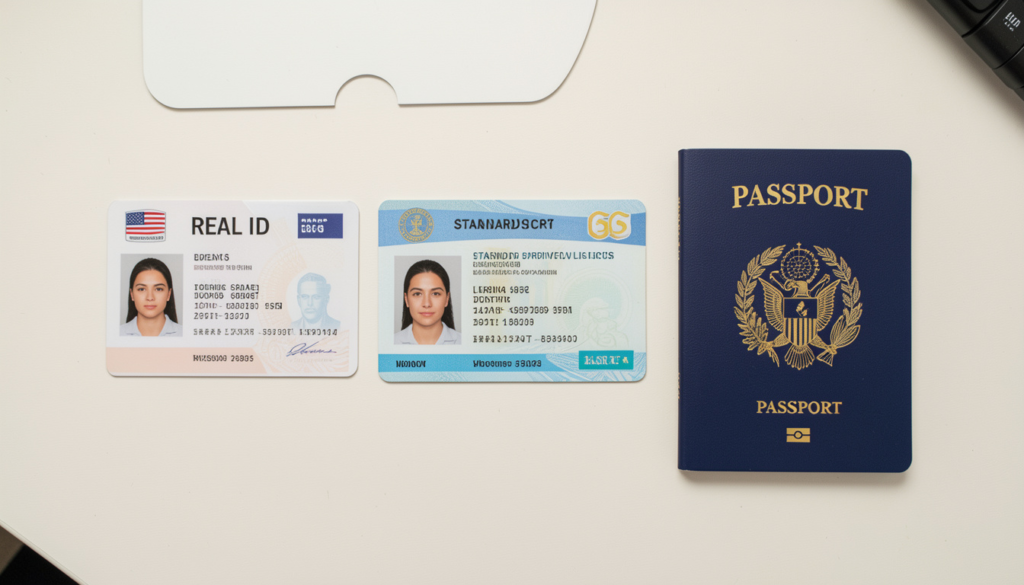
Many travelers wonder whether they should get a REAL ID if they already own a passport.
The comparison below makes the differences easier to understand.
| Feature | REAL ID | Standard License | U.S. Passport |
| Drive a Vehicle | ✅ | ✅ | ❌ |
| Domestic Flights | ✅ | ❌ (by itself after enforcement) | ✅ |
| International Flights | ❌ | ❌ | ✅ |
| Federal Facilities | ✅ | Limited | ✅ |
| TSA Accepted | ✅ | Limited | ✅ |
| Easy to Carry Daily | ✅ | ✅ | Less Convenient |
Which One Is Best?
Choose a REAL ID if:
- You frequently fly within the United States.
- You want to use your driver’s license for TSA screening.
- You prefer not to carry your passport for domestic trips.
Choose a passport if:
- You travel internationally.
- You already use your passport as your primary ID.
- You don’t mind carrying it during domestic travel.
Many Americans choose to have both.
REAL ID vs. Passport Card
A Passport Card is different from a traditional passport book.
| Feature | REAL ID | Passport Card |
| Domestic Flights | ✅ | ✅ |
| International Air Travel | ❌ | ❌ |
| Land Border Crossing | ❌ | ✅ (Eligible countries only) |
| Driver’s License | ✅ | ❌ |
| Everyday Use | Excellent | Good |
If you drive regularly, a REAL ID is usually more practical because it combines driving privileges with TSA-approved identification.
State-by-State Differences
Although every REAL ID follows federal standards, individual states may have slight differences.
These may include:
- Appointment systems
- Fees
- Card design
- Processing times
- Accepted residency documents
- Online application options
For example:
| Area | May Vary by State |
| Appointment Required | Yes / No |
| Application Fee | Different |
| Mailing Time | Different |
| Online Pre-Application | Available in some states |
| Card Appearance | Different star design |
Always review your state’s DMV requirements before applying.
What Happens If You Miss the REAL ID Deadline?
Many people worry they’ll never be able to fly again if they don’t obtain a REAL ID before the deadline.
Fortunately, that’s not true.
If you don’t have a REAL ID, you can still board a domestic flight if you present another TSA-approved form of identification, such as:
- U.S. Passport
- Passport Card
- Military ID
- Permanent Resident Card
- Trusted Traveler Card
However, if your only identification is a non-compliant driver’s license, you may not be allowed through the TSA security checkpoint.
Planning ahead helps avoid last-minute travel problems.
Can You Upgrade Later?
Yes.
Even if the REAL ID deadline has passed, you can still apply for a REAL ID whenever you’re ready.
Many people choose to upgrade:
- During license renewal
- Before an upcoming trip
- After moving to another state
- When replacing a lost license
There is no requirement to wait until your license expires.
Common Mistakes People Make
Many REAL ID applications are delayed because of simple errors that could have been avoided.
1. Waiting Until the Last Minute
As travel seasons approach, DMV appointment availability may become limited.
Apply well before your next planned flight.
2. Bringing Incorrect Documents
Photocopies, expired documents, or incomplete paperwork are common reasons applications cannot be processed.
Always bring original or certified copies when required.
3. Ignoring Name Differences
If your birth certificate says “Sarah Johnson” but your driver’s license says “Sarah Smith,” you’ll likely need documentation showing the legal name change.
4. Using an Old Address
Your proof of residency should reflect your current address.
Old utility bills or outdated bank statements may not be accepted.
5. Assuming Every License Is a REAL ID
Many people think every driver’s license automatically qualifies.
Check for the required compliance mark (usually a star) before relying on your license for air travel.
6. Forgetting Payment
Some DMV offices accept only certain payment methods.
Verify accepted payment options before your visit.
7. Not Making an Appointment
Walk-in availability can be limited.
Scheduling an appointment usually saves time.
Pros and Cons of Getting a REAL ID
| Pros | Cons |
| TSA-approved for domestic flights | Requires extra documentation |
| Easier airport security experience | DMV visit may be required |
| Accepted at many federal facilities | Fees vary by state |
| More secure identification | Processing may take several weeks |
| Convenient daily identification | Appointment availability can be limited during busy periods |
For most travelers, the advantages outweigh the inconvenience of applying.
Expert Tips
Travel professionals recommend planning ahead rather than waiting until your next trip.
Apply During License Renewal
If your driver’s license is due for renewal soon, consider upgrading to a REAL ID at the same time.
Keep Digital Copies
While you’ll usually need original documents for your application, storing secure digital copies of important records can make future renewals easier.
Check Expiration Dates
Before every trip, verify that your REAL ID or other TSA-approved identification is still valid.
Arrive Early for DMV Appointments
Bring all required paperwork and arrive 10–15 minutes early to avoid unnecessary stress.
Verify Travel Requirements Before Flying
Airline and TSA policies can change. Check your identification requirements before heading to the airport.
REAL ID Deadline and Domestic Air Travel
For many Americans, the biggest impact of the REAL ID deadline is on domestic air travel. If you’re planning to fly within the United States, having the correct identification is essential to avoid delays at airport security.
A REAL ID makes the check-in and TSA screening process much smoother because it meets federal security standards. However, it is not the only acceptable form of identification for domestic flights.
If you don’t have a REAL ID, you can still fly using another TSA-approved ID, such as a valid U.S. passport or military ID.
The key is to make sure you have an accepted form of identification before arriving at the airport.
What Happens at the TSA Checkpoint?
When you arrive at the airport, you’ll first proceed to the Transportation Security Administration (TSA) security checkpoint.
During this process, a TSA officer will:
- Verify your identification.
- Compare your ID with your boarding pass.
- Confirm your identity.
- Allow you to proceed through security if everything is in order.
If your identification does not meet federal requirements and you don’t have an approved alternative, you may not be allowed to continue through security.
This is why checking your ID before your travel date is so important.
Accepted TSA Identification
The following IDs are generally accepted for domestic air travel.
| Identification | Accepted for TSA? |
| REAL ID Driver’s License | ✅ Yes |
| REAL ID State ID Card | ✅ Yes |
| U.S. Passport | ✅ Yes |
| U.S. Passport Card | ✅ Yes |
| Military ID | ✅ Yes |
| Permanent Resident Card | ✅ Yes |
| Global Entry Card | ✅ Yes |
| NEXUS Card | ✅ Yes |
| SENTRI Card | ✅ Yes |
| Enhanced Driver’s License (select states) | ✅ Yes |
| Tribal Photo ID | ✅ Yes |
Always ensure your identification is current and not expired.
Can You Fly Without a REAL ID?
Yes—in many cases.
The REAL ID deadline does not mean you are prohibited from flying if you don’t have a REAL ID.
You can still board a domestic flight if you present another TSA-approved identification, such as:
- A valid U.S. passport
- A passport card
- A military ID
- A Permanent Resident Card
- A DHS Trusted Traveler card
However, if your only ID is a standard driver’s license that is not REAL ID compliant, you may encounter problems at the security checkpoint.
Do Children Need a REAL ID?
Parents often wonder whether children must carry a REAL ID for domestic travel.
In general:
- Children under 18 years old do not need to show identification when traveling domestically with a companion.
- The accompanying adult must present acceptable identification.
- Airlines may have their own documentation requirements, especially for unaccompanied minors.
If your child is traveling alone, check with the airline before the trip.
Does a REAL ID Replace a Passport?

No.
This is one of the most common misconceptions.
A REAL ID is designed primarily for:
- Domestic air travel
- Entry to certain federal facilities
- Access to some military installations
A REAL ID cannot be used instead of a passport for international air travel.
Here’s a simple comparison:
| Travel Type | REAL ID | Passport |
| Domestic Flights | ✅ Yes | ✅ Yes |
| International Flights | ❌ No | ✅ Yes |
| Driving | ✅ Yes | ❌ No |
| Everyday Identification | ✅ Yes | Limited |
If you travel internationally, you’ll still need a valid passport.
What About Cruises?
Whether you need a REAL ID for a cruise depends on the itinerary.
Closed-Loop Cruises
Some cruises that begin and end at the same U.S. port may allow alternative documents, depending on the cruise line and destination.
International Cruises
If your cruise visits foreign countries, you’ll often need a passport.
Before your trip:
- Check with your cruise line.
- Review destination requirements.
- Confirm what identification is accepted.
A REAL ID alone may not be sufficient for international cruise travel.
Traveling to U.S. Territories
Requirements vary depending on your destination.
Popular U.S. territories include:
- Puerto Rico
- U.S. Virgin Islands
- Guam
- American Samoa
- Northern Mariana Islands
Some destinations can be visited using a REAL ID for domestic travel, while others may have additional documentation requirements.
Always verify travel requirements before departure.
TSA Electronics Rules (2026 Guide): What You Can Bring Through Airport Security Without Problem
Military Members and REAL ID
Military personnel generally have additional identification options.
Accepted forms often include:
- Active-duty military ID
- Department of Defense identification
- Certain dependent military IDs
These forms of identification are generally accepted for TSA screening.
Family members should confirm which IDs they can use before traveling.
College Students and REAL ID
Many students use their driver’s license when flying home during school breaks.
If you’re a college student:
- Check whether your driver’s license is REAL ID compliant.
- Don’t assume your student ID is accepted by TSA.
- Consider obtaining a REAL ID before your next semester break.
Planning ahead helps avoid travel disruptions during busy holiday seasons.
Seniors and REAL ID
Older adults follow the same federal identification requirements as other travelers.
Helpful tips for seniors include:
- Apply before your current license expires.
- Bring original documents.
- Ask about DMV assistance services if needed.
- Schedule appointments during less busy hours.
Many DMV offices offer accessibility services for seniors and individuals with disabilities.
Business Travelers
Frequent business travelers can benefit significantly from obtaining a REAL ID.
Advantages include:
- Faster airport preparation
- One less document to carry
- Easier domestic travel
- Reduced risk of forgetting a passport for U.S. trips
If you fly several times a year, a REAL ID is a practical investment.
What If Your REAL ID Is Lost Before Your Trip?
Losing your identification just before a flight can be stressful.
If your REAL ID is lost or stolen:
- Report the loss if required by your state.
- Request a replacement through your DMV.
- Bring another TSA-approved ID if available.
- Arrive at the airport early in case additional identity verification is needed.
Having a valid passport as a backup can be especially helpful.
Travel Checklist Before Heading to the Airport
Use this checklist to make sure you’re prepared.
✔ Identification
- REAL ID or another TSA-approved ID
- Passport (if traveling internationally)
✔ Flight Documents
- Boarding pass
- Airline confirmation
✔ Travel Essentials
- Wallet
- Phone
- Charger
- Medications
✔ Before Leaving Home
- Confirm your ID has not expired.
- Verify your flight details.
- Check TSA baggage rules.
- Arrive at the airport early.
Travel Tips for a Smooth Airport Experience
Arrive Early
Give yourself enough time for check-in, security, and unexpected delays.
Double-Check Your Identification
Make sure the name on your airline ticket matches your identification exactly.
Keep Your ID Accessible
Store your REAL ID in an easy-to-reach location to speed up the security process.
Monitor Airline Updates
Weather and schedule changes can happen unexpectedly, so check your airline’s app or website before leaving.
Have a Backup Plan
If you own a passport, bring it when practical—especially if you’re unsure about your driver’s license status.
Google Featured Snippet: REAL ID Deadline Explained
Quick Answer:
The REAL ID deadline is the date when adults traveling on domestic commercial flights in the United States generally need a REAL ID-compliant driver’s license or another TSA-approved form of identification, such as a valid U.S. passport, to pass through airport security.
If you do not have a REAL ID, you can still travel domestically by presenting another acceptable TSA-approved ID.
People Also Ask (PAA)
What happens if I don’t have a REAL ID?
If you don’t have a REAL ID, you may still board a domestic flight by showing another TSA-approved identification, such as a valid U.S. passport, passport card, military ID, or Permanent Resident Card.
If your only identification is a non-compliant driver’s license, you may not be allowed through the TSA security checkpoint.
Is a passport better than a REAL ID?
It depends on your travel needs.
A passport is required for international travel and is also accepted for domestic flights.
A REAL ID is more convenient for everyday use because it functions as your driver’s license while also meeting federal identification requirements for domestic air travel.
Can I get a REAL ID after the deadline?
Yes.
The REAL ID deadline does not prevent you from applying later. You can apply for a REAL ID at any time through your state’s licensing agency.
However, if you plan to fly before receiving your REAL ID, you’ll need another TSA-approved form of identification.
How long does it take to receive a REAL ID?

Processing times vary by state.
Most applicants receive their physical card by mail within several business days to a few weeks after completing their DMV appointment.
Applying well before your travel date is recommended.
Does every state issue REAL IDs?
Yes.
All U.S. states, the District of Columbia, and U.S. territories issue REAL ID-compliant driver’s licenses and identification cards that meet federal standards.
Voice Search Optimized Questions
Many people now search using voice assistants like Siri, Google Assistant, and Alexa. Here are common voice-search queries related to the REAL ID deadline.
“Do I need a REAL ID to fly in the United States?”
Generally, yes—unless you have another TSA-approved identification such as a valid passport.
“Can I use my passport instead of a REAL ID?”
Yes.
A valid U.S. passport is accepted for domestic and international air travel and can be used instead of a REAL ID.
“How do I know if my driver’s license is a REAL ID?”
Look for a star in the upper corner of your driver’s license or state-issued identification card. The exact design varies by state.
“Can I fly with an expired REAL ID?”
An expired REAL ID may not be accepted for TSA screening. Check current TSA policies and renew your identification before traveling.
“What documents do I need for a REAL ID?”
Most applicants need:
- Proof of identity
- Social Security Number
- Two proofs of residency
- Name change documents (if applicable)
Common Mistakes to Avoid
Many travelers experience unnecessary stress because of avoidable mistakes. Understanding these issues before the REAL ID deadline can help make your trip much smoother.
❌ Waiting Until Your Vacation Is Booked
One of the biggest mistakes is applying only after purchasing airline tickets.
DMV appointment availability may be limited during peak travel seasons.
Apply early to avoid last-minute problems.
❌ Assuming Every Driver’s License Is Accepted
Not every state-issued driver’s license is REAL ID compliant.
Check your card carefully before your travel date.
❌ Bringing Incomplete Documents
Applicants are often turned away because they forget:
- Residency documents
- Social Security proof
- Legal name change records
Use a checklist before your DMV visit.
❌ Ignoring Expiration Dates
Your REAL ID should be valid on your travel date.
Renew it before expiration to avoid unexpected complications.
❌ Forgetting a Backup ID
If you already have a passport, keeping it available provides extra peace of mind during travel.
Expert Tips for Travelers
Experienced travelers recommend planning well ahead of the REAL ID deadline rather than waiting until the last minute.
Apply During a Less Busy Season
DMV offices are often less crowded outside major holidays and summer travel periods.
Store Important Documents Safely
Keep original documents together in a secure location so they’re easy to find when needed.
Double-Check Airline Reservations
Your airline ticket should match the name shown on your REAL ID exactly.
Even minor spelling differences can create delays.
Review TSA Guidelines Before Every Trip
Airport procedures occasionally change.
Checking current travel requirements before leaving home can help you avoid surprises.
Keep Emergency Identification
If possible, maintain both a REAL ID and a valid passport.
Having two accepted forms of identification gives you additional flexibility if one is lost or expires.
FAQs
What is the REAL ID deadline?
The REAL ID deadline is the point when adults generally need a REAL ID-compliant driver’s license or another TSA-approved ID for domestic commercial flights and certain federal facilities.
Is a REAL ID mandatory?
Not for everyone.
If you have another TSA-approved identification, such as a passport, you may use that instead.
Can I still drive without a REAL ID?
Yes.
A standard driver’s license still allows you to drive if it remains valid under your state’s laws.
Does a REAL ID replace my passport?
No.
A REAL ID cannot be used for international air travel.
Can I use my passport instead of a REAL ID?
Yes.
A valid passport is accepted by TSA for domestic flights.
How can I tell if I already have a REAL ID?
Look for a star in the upper corner of your driver’s license or state ID.
What happens if my REAL ID is lost?
Request a replacement from your state’s licensing agency and use another TSA-approved ID if you need to travel before the replacement arrives.
Can I renew my REAL ID online?
Some states allow online renewals in certain situations, but first-time REAL ID applications generally require an in-person visit.
Are children required to have a REAL ID?
Generally, children under 18 do not need identification when traveling domestically with an accompanying adult.
Is the REAL ID accepted everywhere?
A REAL ID is accepted for domestic air travel and entry to certain federal facilities, but it is not a substitute for a passport when traveling internationally.
Conclusion
Understanding the REAL ID deadline is one of the most important steps you can take before planning domestic travel in the United States. Whether you’re flying for a family vacation, a business meeting, or a weekend getaway, having the right identification helps ensure a smooth airport experience.
If your current driver’s license is already REAL ID compliant, you’re in a good position for future travel. If not, don’t wait until your departure date to find out. Check your license, gather the required documents, and schedule an appointment with your state’s licensing agency if needed.
Remember that a REAL ID is not a replacement for a passport. If you travel internationally, you’ll still need a valid U.S. passport. However, for most domestic travelers, a REAL ID offers a convenient and secure way to meet federal identification requirements.
By planning ahead, checking your documents, and understanding the rules, you can avoid unnecessary delays and travel with confidence.
Read More:TSA PreCheck: The Ultimate 2026 Guide to Faster Airport Security, Costs, Benefits & How to Apply