Traveling within the United States has changed over the past few years, and having the correct identification is now more important than ever. Whether you’re planning a family vacation, a business trip, or simply visiting another state, understanding REAL ID requirements can help you avoid unexpected problems at the airport.
Many Americans still wonder whether they need a REAL ID, how to apply for one, what documents are required, and whether a passport is still necessary. The rules can seem confusing because every state issues its own driver’s licenses while following federal guidelines.
This complete guide explains everything you need to know about REAL ID in simple language. You’ll learn who needs one, how to apply, what documents to bring, common mistakes to avoid, and practical travel tips that make the process much easier.
Quick Answer
REAL ID is a federally compliant driver’s license or identification card that meets security standards established under the REAL ID Act. Most U.S. travelers now need a REAL ID-compliant license, a passport, or another TSA-approved form of identification to board domestic flights and enter certain federal facilities. To obtain one, you’ll typically need proof of identity, your Social Security number, proof of residency, and lawful status before applying through your state’s DMV.
What Is REAL ID?
REAL ID is a driver’s license or identification card that meets federal security standards established by the REAL ID Act of 2005. Although it looks similar to a standard driver’s license, it includes additional verification steps before it is issued.
The law was introduced to improve identification security across the United States. States must verify important documents such as your identity, legal status, Social Security number, and home address before issuing a REAL ID-compliant card.
A REAL ID can be used for many federal purposes, including:
- Boarding domestic commercial flights
- Entering certain federal buildings
- Visiting military bases (where permitted)
- Providing federally accepted identification
Most REAL ID cards display a star in the upper corner, making it easy to recognize that the card complies with federal standards.
What Does a REAL ID Look Like?
Although every state designs its driver’s licenses differently, a REAL ID usually includes a star in the upper-right corner of the card. Some states use a gold star, while others use a black star or another approved symbol.
Besides the star, your REAL ID will include the same personal information found on a regular driver’s license, including:
- Full legal name
- Date of birth
- Address
- Driver’s license number
- Photograph
- Signature
The design may differ by state, but the federal compliance mark identifies it as a REAL ID.
What Is the REAL ID Act?
The REAL ID Act was passed by Congress in 2005 after recommendations from the 9/11 Commission. The goal was to establish stronger security standards for state-issued identification cards and driver’s licenses.
Before the Act, every state followed different procedures when issuing driver’s licenses. This created security challenges because identification standards varied widely across the country.
Today, states must verify applicant information before issuing a REAL ID-compliant license. These stricter standards help reduce identity fraud and improve national security.
Why Was REAL ID Introduced?
The federal government introduced REAL ID to strengthen identity verification and reduce the risk of fraudulent identification.
Some major goals include:
- Improving airport security
- Preventing identity theft
- Standardizing identification across states
- Protecting federal facilities
- Increasing document verification standards
These measures make it more difficult for fake or altered identification documents to be accepted.
Why REAL ID Matters for U.S. Travelers
If you plan to fly within the United States, REAL ID has become one of the most important travel documents you can own. Without a compliant identification card or another TSA-approved document, you may not be allowed to pass through airport security for domestic flights.
Having a REAL ID also simplifies travel because it serves as an accepted form of identification for many federal purposes. Instead of carrying additional documents, travelers can often rely on a single compliant driver’s license.
For frequent travelers, obtaining a REAL ID can save time, reduce stress, and help prevent last-minute travel disruptions.
Benefits of Having a REAL ID
A REAL ID offers several advantages beyond meeting federal requirements.
Easier Domestic Air Travel
A REAL ID allows eligible travelers to use their driver’s license for domestic flights without needing another form of federally accepted identification, provided it meets TSA requirements.
Access to Certain Federal Facilities
Some federal buildings and military installations require federally compliant identification. A REAL ID helps meet these identification requirements.
Better Identity Protection
Since applicants must provide verified documentation, REAL ID cards help reduce fraud and strengthen identity verification.
Greater Peace of Mind
Knowing your identification meets federal standards means you’re better prepared for future travel, government appointments, and official identification checks.
REAL ID Requirements: The Complete 2026 Guide to Documents, Rules, Deadlines & How to Apply
Is REAL ID Mandatory?
One of the biggest misconceptions is that every American must have a REAL ID.
The answer is no.
You are not legally required to obtain one. However, if you plan to board domestic commercial flights using your driver’s license or need access to certain federal facilities, you’ll generally need either:
- A REAL ID-compliant driver’s license
- A U.S. passport
- Another TSA-approved identification document
If you already use a passport for air travel, you may decide that obtaining a REAL ID is optional. However, many people choose to get one because it’s more convenient to carry a driver’s license than a passport for domestic trips.
Key Takeaways
- REAL ID is a federally compliant driver’s license or identification card.
- It improves identity verification and security.
- Most domestic air travelers benefit from having one.
- A REAL ID typically features a star in the upper corner.
- Every state issues its own REAL ID following federal standards.
- You’ll need verified identity and residency documents to apply.
- A passport remains an alternative for domestic flights and international travel.
Who Needs a REAL ID?
Whether you need a REAL ID depends on how you plan to use your identification. While no federal law requires every American to obtain one, many people will find it useful for travel and accessing certain government facilities.
If you regularly travel within the United States, getting a REAL ID is one of the easiest ways to ensure you meet federal identification requirements at airport security checkpoints.
Generally, you should consider getting a REAL ID if you:
- Fly domestically several times a year
- Visit military bases (where accepted)
- Enter secure federal buildings
- Want one federally compliant form of identification
- Prefer using your driver’s license instead of carrying a passport
For most travelers, a REAL ID offers added convenience because it combines driving privileges with federally accepted identification.
Travelers Who Should Get a REAL ID

Many Americans will benefit from upgrading to a REAL ID, especially if they frequently travel for work, family vacations, or school.
Common examples include:
Business Travelers
Professionals who fly often can avoid carrying a passport for domestic trips by using a REAL ID-compliant driver’s license.
Families
Parents traveling with children can simplify airport check-in by having a compliant identification card ready.
College Students
Students attending universities in different states often travel home during holidays. A REAL ID can make airport security much smoother.
Retirees
Many retirees enjoy exploring the country through domestic travel. Having a REAL ID eliminates unnecessary travel concerns.
Government Contractors
Individuals who regularly visit federal facilities may need federally accepted identification for entry.
Who Does NOT Need a REAL ID?
Not everyone needs a REAL ID. If you already have another federally accepted identification document, you may continue using it for approved purposes.
Examples include:
- Valid U.S. Passport
- Passport Card
- Military ID
- Permanent Resident Card
- Trusted Traveler Cards (when accepted)
- Other TSA-approved identification
If you already carry a passport whenever you fly, obtaining a REAL ID is largely a matter of convenience rather than necessity.
Can Children Travel Without a REAL ID?
Yes.
Children under 18 traveling with a companion on domestic flights generally are not required by the TSA to present a REAL ID or driver’s license.
However, airlines may have their own identification policies for minors, so checking before travel is always recommended.
REAL ID Eligibility Requirements
Before applying, make sure you meet your state’s eligibility requirements.
Most applicants must:
- Be eligible for a state-issued driver’s license or ID card
- Verify their identity
- Provide proof of lawful presence
- Present their Social Security Number
- Show proof of residency
- Complete any state-specific requirements
Because licensing is handled by each state’s Department of Motor Vehicles (DMV), exact requirements may vary slightly.
Documents Needed for a REAL ID
One of the most important parts of the application process is bringing the correct documents.
Many applications are delayed simply because applicants arrive without the required paperwork.
Although requirements differ slightly by state, most DMVs ask for documents in four major categories.
1. Proof of Identity
You must prove who you are using original or certified documents.
Examples include:
- U.S. Passport
- Certified Birth Certificate
- Certificate of Naturalization
- Permanent Resident Card
- Valid Employment Authorization Document
Photocopies are usually not accepted.
2. Social Security Number
You’ll also need proof of your Social Security Number.
Accepted documents often include:
- Social Security Card
- W-2 Form
- SSA-1099 Form
- Non-SSA 1099 Form
- Recent Pay Stub showing your full SSN
Always verify your state’s accepted document list before your appointment.
3. Proof of Residency
Most states require two documents proving where you currently live.
Common examples include:
- Utility bill
- Mortgage statement
- Lease agreement
- Bank statement
- Credit card statement
- Property tax bill
- Vehicle registration
- Insurance policy
These documents usually must display:
- Your full name
- Your residential address
4. Proof of Lawful Status
Applicants must also demonstrate legal authorization to live in the United States.
Examples may include:
- U.S. Passport
- Birth Certificate
- Permanent Resident Card
- Certificate of Citizenship
- Immigration documents
REAL ID Documents Checklist
Before leaving home, make sure you have everything you need.
✔ REAL ID Checklist
✅ Proof of identity
✅ Social Security document
✅ Two proofs of residency
✅ Proof of lawful presence (if required)
✅ Current driver’s license or ID
✅ Payment method for DMV fees
✅ Appointment confirmation (if required)
Keeping your documents organized in a folder can help speed up the application process.
REAL ID vs Standard Driver’s License
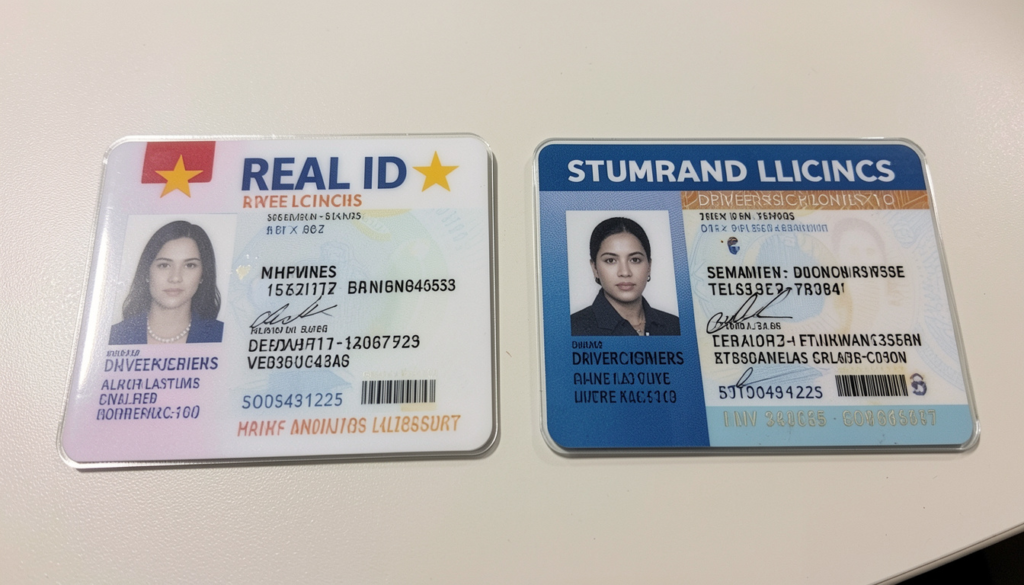
Many people assume there is little difference between a standard driver’s license and a REAL ID. While both allow you to drive legally, only one meets federal identification requirements.
| Feature | REAL ID | Standard Driver’s License |
| Drive a vehicle | ✅ Yes | ✅ Yes |
| Domestic flights | ✅ Yes (when required) | ❌ No |
| Enter federal facilities | ✅ Yes (where applicable) | ❌ Limited |
| Federal compliance | ✅ Yes | ❌ No |
| Identity verification | Enhanced | Standard |
| Requires additional documents | ✅ Yes | Usually fewer |
For frequent travelers, the extra verification process is worth the long-term convenience.
How Long Does It Take to Get a REAL ID?
Processing times vary depending on the state and the time of year.
Typical timelines include:
| Step | Estimated Time |
| DMV appointment | 20–60 minutes |
| Document review | Same day |
| Card production | 1–3 weeks |
| Delivery by mail | Usually within 7–20 days |
Some states issue a temporary paper license while your permanent card is mailed.
How Much Does a REAL ID Cost?
The cost of a REAL ID depends on your state.
In many states, the fee is similar to renewing a driver’s license. Others may charge a small additional fee for upgrading to a REAL ID-compliant card.
Factors affecting cost include:
- First-time application
- License renewal
- Duplicate card
- Replacement card
- State-specific administrative fees
Checking your state’s DMV website before scheduling an appointment can help you avoid surprises.
Tips to Prepare for Your DMV Appointment
Getting ready before your appointment can save time and reduce stress.
Here are a few simple tips:
- Review your state’s document checklist.
- Bring original documents instead of copies.
- Double-check that names match across all documents.
- Arrive at least 15 minutes early.
- Complete any online forms in advance if available.
- Organize paperwork in a folder for quick access.
- Keep payment ready for application fees.
A little preparation can make the process much smoother.
Key Takeaways
- Not everyone is required to get a REAL ID, but many travelers benefit from having one.
- You typically need proof of identity, Social Security, residency, and lawful presence.
- Requirements can vary slightly by state.
- A REAL ID is different from a standard driver’s license because it meets federal security standards.
- Bringing complete and original documents helps avoid delays at the DMV.
How to Apply for a REAL ID: Step-by-Step Guide
Applying for a REAL ID is straightforward when you know what to expect. While the exact process varies slightly by state, the overall steps are very similar across the United States.
Planning ahead and gathering your documents before visiting the DMV can save time and prevent delays.
Step 1: Check Your State’s Requirements
Before scheduling an appointment, visit your state’s Department of Motor Vehicles (DMV) website to review the latest REAL ID requirements.
Things to check include:
- Required documents
- Appointment availability
- Application fees
- Processing times
- Online pre-application options
- Office locations
Some states allow you to upload documents online before your appointment, making the in-person visit faster.
Step 2: Gather Your Documents
Collect all required original documents before heading to the DMV.
Most applicants need:
- Proof of identity
- Proof of lawful presence
- Social Security Number
- Two proofs of residency
- Current driver’s license or identification card
Double-check that the names on all documents match. Even a small difference can delay your application.
Step 3: Schedule a DMV Appointment
Many DMV offices now require or strongly recommend appointments.
Booking in advance offers several benefits:
- Shorter wait times
- Faster service
- Guaranteed appointment slot
- Better customer experience
Walk-in appointments may still be available in some locations, but wait times can be significantly longer.
Step 4: Visit the DMV
Bring all required documents with you on the day of your appointment.
During your visit, DMV staff will:
- Review your documents
- Verify your identity
- Confirm your address
- Check your Social Security information
- Capture a new photograph (if required)
- Collect your application fee
The entire appointment typically takes between 20 and 60 minutes, depending on the office.
Step 5: Receive Your REAL ID
After your application is approved, you’ll usually receive:
- A temporary paper license or ID (in many states)
- Your permanent REAL ID card by mail within 1–3 weeks
Delivery times vary by state and processing volume.
What Happens If You Don’t Have a REAL ID?
If you arrive at the airport without a REAL ID-compliant license, you may still be able to board your flight if you present another TSA-approved form of identification, such as a valid U.S. passport.
However, if you don’t have either a REAL ID or another acceptable ID, you could face delays, additional screening, or even be denied entry through the security checkpoint.
To avoid unnecessary stress, check your identification well before your travel date.
REAL ID Deadline: Why It Matters
The federal government has established enforcement for REAL ID requirements for domestic air travel and access to certain federal facilities.
If your driver’s license is not REAL ID-compliant, you’ll generally need another TSA-approved identification document, such as a passport, to board domestic commercial flights.
Because enforcement dates and policies can occasionally change, it’s always a good idea to verify the latest information with your state DMV and the Transportation Security Administration (TSA) before traveling.
REAL ID vs Passport
Many travelers ask whether they should get a REAL ID if they already have a passport.
The answer depends on how you travel.
Comparison Table
| Feature | REAL ID | U.S. Passport |
| Domestic flights | ✅ Yes | ✅ Yes |
| International flights | ❌ No | ✅ Yes |
| Proof of identity | ✅ Yes | ✅ Yes |
| Driver’s license | ✅ Yes | ❌ No |
| Fits easily in wallet | ✅ Yes | ❌ No |
| Travel outside the U.S. | ❌ No | ✅ Yes |
| Federal identification | ✅ Yes | ✅ Yes |
When a REAL ID Is the Better Choice
A REAL ID is ideal if you:
- Mostly travel within the United States
- Want one convenient wallet-sized ID
- Drive regularly
- Prefer not to carry your passport on domestic trips
When a Passport Is Better
A passport is the better option if you:
- Travel internationally
- Need proof of citizenship abroad
- Frequently visit multiple countries
- Require an internationally recognized travel document
Many Americans choose to have both.
REAL ID vs Enhanced Driver’s License (EDL)
Some states issue an Enhanced Driver’s License (EDL), which is different from a standard REAL ID.
Here’s how they compare:
| Feature | REAL ID | Enhanced Driver’s License |
| Domestic flights | ✅ Yes | ✅ Yes |
| Driver’s license | ✅ Yes | ✅ Yes |
| Land/Sea travel to Canada & Mexico (where applicable) | ❌ No | ✅ Yes |
| Federal compliance | ✅ Yes | ✅ Yes |
| Available in every state | ✅ Most states issue REAL IDs | ❌ Only select states offer EDLs |
If your state offers an Enhanced Driver’s License, compare its benefits before deciding which option best meets your travel needs.
Can You Upgrade Your Current Driver’s License?

Yes. In most states, you don’t need to wait until your driver’s license expires.
You can usually upgrade your existing license to a REAL ID by:
- Scheduling a DMV appointment
- Bringing the required documents
- Paying the applicable fee
- Receiving your new compliant license
Upgrading early can help you avoid long lines as enforcement deadlines approach.
What If Your Name Has Changed?
If the name on your documents doesn’t match your current legal name, you’ll likely need additional paperwork.
Common documents include:
- Marriage certificate
- Divorce decree
- Court order for name change
- Adoption records (if applicable)
Bring original or certified copies to help the DMV verify your identity.
What If You Lost Your Birth Certificate?
A missing birth certificate doesn’t necessarily prevent you from getting a REAL ID.
Depending on your situation, you may be able to use:
- Valid U.S. Passport
- Certified replacement birth certificate
- Certificate of Naturalization
- Certificate of Citizenship
- Other approved identity documents
If you need a replacement birth certificate, request one from the vital records office in the state where you were born before your DMV appointment.
Can Non-U.S. Citizens Get a REAL ID?
In many states, lawful permanent residents and certain other individuals with authorized legal status may qualify for a REAL ID if they meet state and federal documentation requirements.
Applicants may need to provide immigration or residency documents in addition to standard identity and residency records.
Because eligibility rules can vary, it’s important to check your state’s DMV guidelines.
Is a REAL ID Valid for International Travel?
No.
A REAL ID is not a replacement for a passport.
It cannot be used to:
- Fly to another country
- Enter most foreign countries
- Replace a passport for international travel
- Serve as an international travel document
For any trip outside the United States, you’ll generally need a valid passport and, depending on your destination, a visa or other travel documents.
Practical Example
Imagine you’re flying from New York to California for a family vacation.
Scenario A
You have a REAL ID.
You arrive at the airport, show your REAL ID at the TSA checkpoint, pass security, and board your flight without needing a passport.
Scenario B
You don’t have a REAL ID, but you have a valid U.S. passport.
You present your passport instead and continue through security without issue.
Scenario C
You have neither a REAL ID nor another TSA-approved identification.
You may experience significant delays, additional screening, or may not be permitted through security.
Planning ahead can help you avoid these situations.
Key Takeaways
- Applying for a REAL ID is a simple process when you gather the correct documents.
- A REAL ID is excellent for domestic travel but cannot replace a passport for international trips.
- Enhanced Driver’s Licenses offer additional benefits in certain states.
- Check that your legal name matches across all documents before applying.
- Upgrading your current license early can save time and reduce stress.
REAL ID Renewal and Replacement
Once you receive your REAL ID, you’ll need to renew it according to your state’s driver’s license or identification card renewal schedule. Renewal periods vary by state, but most licenses are valid for several years before they expire.
When it’s time to renew, some states allow eligible drivers to complete part or all of the renewal process online, while others require an in-person visit to the DMV. If your personal information has changed—such as your legal name or home address—you may need to provide updated documents again.
If your REAL ID is lost, stolen, or damaged, contact your state’s DMV as soon as possible to request a replacement. Many states offer online replacement services, making the process faster and more convenient.
REAL ID Costs
There is no single nationwide price for a REAL ID because each state sets its own fees.
In many states, the cost is similar to:
- Renewing a driver’s license
- Applying for a new driver’s license
- Replacing a lost driver’s license
Some states charge a small additional fee for upgrading to a REAL ID-compliant card, while others include it in the standard licensing fee.
Factors That Can Affect the Cost
- Your state of residence
- New application or renewal
- Replacement card
- Duplicate license
- Expedited services (if available)
Checking your state’s DMV website before your appointment is the best way to confirm the exact fee.
Common Mistakes to Avoid

Many REAL ID applications are delayed because of simple, avoidable mistakes. Paying attention to the details before visiting the DMV can save you time and frustration.
1. Bringing Photocopies Instead of Original Documents
Most DMVs require original or certified copies. Regular photocopies are usually not accepted.
Tip: Always bring original documents unless your state specifically allows certified copies.
2. Mismatched Names on Documents
If the name on your birth certificate, Social Security card, or other documents doesn’t match your current legal name, your application may be delayed.
Tip: Bring legal name change documents, such as a marriage certificate or court order.
3. Forgetting Proof of Residency
Many applicants remember their passport or birth certificate but forget to bring two documents proving their current address.
Tip: Double-check your state’s residency requirements before your appointment.
4. Waiting Until the Last Minute
As travel deadlines approach, DMV offices often become much busier.
Tip: Apply early to avoid long wait times and appointment shortages.
5. Not Checking State-Specific Rules
Although REAL ID follows federal standards, each state has slightly different application procedures.
Tip: Review your state’s DMV website before gathering documents.
Expert Tips for a Smooth REAL ID Application
These practical tips can help you complete the process quickly and avoid unnecessary delays.
✔ Organize Documents in Advance
Place all required paperwork in a folder the night before your appointment.
✔ Book an Early Morning Appointment
DMV offices are often less crowded early in the day, reducing your waiting time.
✔ Verify Your Address
Make sure the address on your proof of residency documents matches your current residence.
✔ Check Expiration Dates
Bring valid, unexpired identification whenever possible.
✔ Review Everything Before Leaving Home
Take a few minutes to review the DMV checklist one final time before your appointment.
A little preparation can save hours of frustration.
Pros and Cons of REAL ID
| Pros | Cons |
| Accepted for domestic air travel | Cannot replace a passport for international travel |
| Meets federal identification standards | Requires additional documentation to obtain |
| Convenient wallet-sized identification | DMV appointments may be required |
| Reduces the need to carry a passport for domestic flights | Fees vary by state |
| Helps access certain federal facilities | Processing time varies |
For most U.S. residents, the advantages outweigh the disadvantages, especially if they travel domestically.
FAQs
What is a REAL ID?
A REAL ID is a federally compliant driver’s license or identification card that meets security standards established under the REAL ID Act.
Do I need a REAL ID to fly within the United States?
A REAL ID-compliant license is one acceptable form of identification for domestic flights. A valid U.S. passport or another TSA-approved ID can also be used.
Can I use a passport instead of a REAL ID?
Yes. A valid U.S. passport is accepted for domestic and international air travel.
Is a REAL ID mandatory?
No. You are not legally required to obtain one. However, if you don’t have a REAL ID, you’ll generally need another TSA-approved identification document for certain federal purposes, including domestic air travel.
How long does it take to receive a REAL ID?
Most applicants receive their card by mail within one to three weeks, although processing times vary by state.
Does every state issue REAL IDs?
Yes. States issue REAL ID-compliant driver’s licenses and identification cards that meet federal standards, though designs and procedures may vary.
Can I get a REAL ID online?
Most states require an in-person visit to verify your identity and documents, although some allow you to complete parts of the application online.
Is a REAL ID the same as a passport?
No. A REAL ID is for federally accepted identification within the United States, while a passport is required for international travel.
Can I upgrade my existing driver’s license?
Yes. Most states allow eligible drivers to upgrade their current license to a REAL ID before it expires.
What happens if I don’t have a REAL ID?
If you don’t have a REAL ID, you can generally use another TSA-approved form of identification, such as a valid passport, for domestic flights and other applicable federal purposes.
Conclusion
A REAL ID is more than just an updated driver’s license—it’s an important form of federally compliant identification that can make domestic travel and access to certain federal facilities much easier.
Applying early, gathering the correct documents, and understanding your state’s requirements can help you avoid delays and ensure you’re prepared well before your next trip.
Whether you’re a frequent flyer, a business traveler, or planning your next family vacation, obtaining a REAL ID is a smart step toward hassle-free travel. Check your state’s DMV requirements, schedule your appointment, and upgrade your identification with confidence.
Read More: TSA Checked Baggage Rules 2026: 15 Essential Packing Tips Every U.S. Traveler Must Know